


17 Oct [Coffee Roaster] Cast-Iron Drum vs. Stainless Steel Drum: Which Is Better?
Today I sat down at the keyboard to take a deeper look at coffee roaster drums.
What exactly is the difference between a cast-iron drum and a stainless steel (STS) drum, and why are these materials used?
“If you are going to use a cast-iron roaster drum, know why it is used!”
Let’s get started!
[Cast-Iron Drum]
Let’s begin by sorting out the terminology. Are ‘cast drum’ and ‘cast roaster’ really the right terms?
Casting is the general term for making something by pouring. Anything made by pouring liquid metal into a mold is a casting.
It is common to compare cast drums with STS drums, but since stainless steel is a material, I think the cast side should also be compared by material.
Stainless steel can be cast as well.
In that sense, the base material of what we commonly call a casting is cast iron.
In practice, though, rather than ordinary cast iron, what is used is ductile iron, which is generally lumped together as ‘scrap iron.’
They throw in a bit of everything and melt it all together in a furnace.
For convenience, I will treat cast drums as cast-iron drums.
So what are the characteristics of a cast-iron drum?
Just think of the characteristics of cast iron as they are. First, one advantage is that its thickness gives it good heat retention.
Conducted heat does not concentrate on the part facing the flame; it spreads evenly.
As with meat, coffee must not burn in only one spot, so this advantage makes it well suited to roasting.
That famous Lodge pan is cast iron, after all.
Imagine grilling a steak or coffee beans in an aluminum pot. What would happen?
That is exactly the difference.
Cast iron (cast metal) is used so that conducted heat can be applied evenly, without burning.
Let’s look into it a little further.
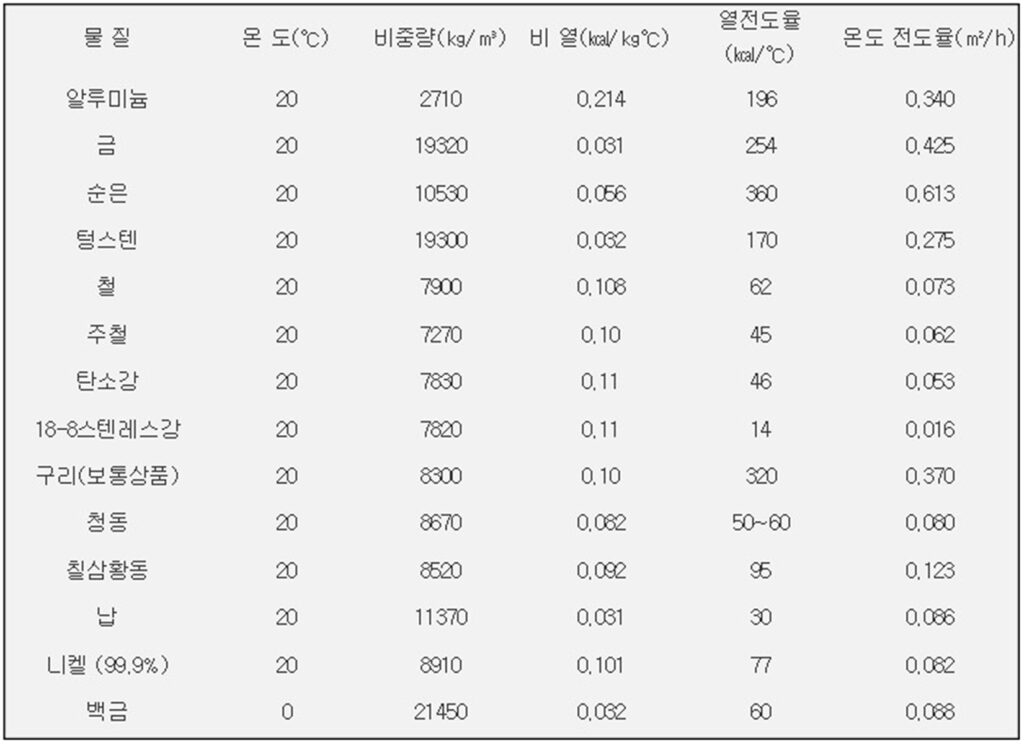
As the table above shows, cast iron has a thermal conductivity of 45, which is on the fairly low side.
But given the nature of castings, if they are also thick, the figure will drop even lower, won’t it?
Thermal conductivity / thickness = thermal transmittance
Because the cast drums in common use are thick, their thermal transmittance is low.
1 / thermal transmittance = thermal resistance
If heat passes through poorly, where does all that heat go? Right: in other words, it means the material retains heat to a high degree.
In short, a thick cast-iron drum holds a large amount of heat inside the drum, and because that heat is spread evenly through the drum itself, it acts as a low-conductivity body that,
without scorching the surface,
has the advantage of cooking food ingredients evenly.
But as the way of the world goes, doesn’t everything have its pros and cons?
The drawbacks of a cast-iron drum: it is heavy, it is thick, it rusts, it is brittle (cast iron), and it cannot be welded, so
these points need to be considered carefully.
[Stainless Steel (STS) Drum]
Now let’s look at STS drums. Today, every roaster except Giesen uses stainless steel as the drum material.
The general perception still seems to rank them below cast-iron drums. Of course, there are exceptions.
Probat! Loring, and others.
Haha
As you may have noticed, the perception that expensive things look good, as Veblen described, seems to hold true everywhere.
Now let’s take a look. Judging by material properties alone, is stainless steel really inferior to cast iron?
As I mentioned earlier, the reason cast iron is used is that it is a low conductor.
Now look at the table above again and compare it with stainless steel.
The thermal conductivity of stainless steel is much lower than that of cast iron. So you can get a similar effect without making it thick.
If stainless steel were cast and used the way cast iron is, the story would be completely different.
If the merits of cast iron are that it cooks evenly and that its low thermal conductivity keeps it from burning, then stainless steel is even better on those very points.
So I would urge you not to believe the conventional claim that ‘cast is better.’
[In a Roaster, Structural Balance Is What Matters]
In reality, many factors work together in a roaster.
In other words, balance matters most!
The design must be well proportioned in terms of the heat output of the heat source and the material used.
This takes planning, the design that follows from it, and trial and error.
If you use a thick drum but the heat is insufficient, how could the result be any good?
And is it really the answer to make the STS thick no matter what, just to lower conductivity?
The point of this article is that it cannot be judged in such a one-dimensional way.
Saying ‘this is better, that is better’ based on isolated points is only a very low-level judgment.
When a particular material has been chosen in product design, is there a plan suited to that material?
And whether the end result is well balanced: I want to stress once more that a comprehensive judgment is what matters.
No Comments