

03 Aug SIEBENSTER 120 kg Coffee Roaster Design Differences
It has been nearly 2 years since SIEBENSTER changed its OEM manufacturer.
SIEBENSTER currently has an exclusive contract with OPP, a roaster-specialist manufacturer in Ho Chi Minh City, Vietnam, and
produces high-quality large machines.
In this post, we introduce the ‘SIEBENSTER 120 kg large roaster,’ which has recently been attracting attention in the market, and how it differs from products made by other manufacturers, both technically,
and structurally, based on objective facts.
First, our partner OPP was founded by core engineers who struck out on their own from
VNT, a company with a 30-year tradition that is indispensable in the history of roaster manufacturing in Vietnam.
In particular, OPP’s CEO was a mechanical engineer and a key person at VNT, and has a track record of developing and producing, in collaboration with Neotec of Hamburg, Germany, 500 kg-class
ultra-large industrial plant equipment.
As such, it is the company in Vietnam that most accurately understands the mechanisms of large hot-air roasters.
(The video below shows NEOTEC’s 500 kg-class plant equipment, in which OPP took part.)
The Key to Choosing a Large Roaster: Insulation and Safety
Because of the recent polarization of the coffee market, demand and inquiries for large machines are noticeably increasing in Korea as well. Because of the high price barrier of European-made or Korean-made large equipment, machines produced in Vietnam are emerging as a reasonable alternative.
However, similar appearance does not mean the internal design and safety are the same.
To show why the SIEBENSTER 120 kg product differs from other companies’ products, we will compare them through the most important factor: the insulation method used for the burner and drum chamber.
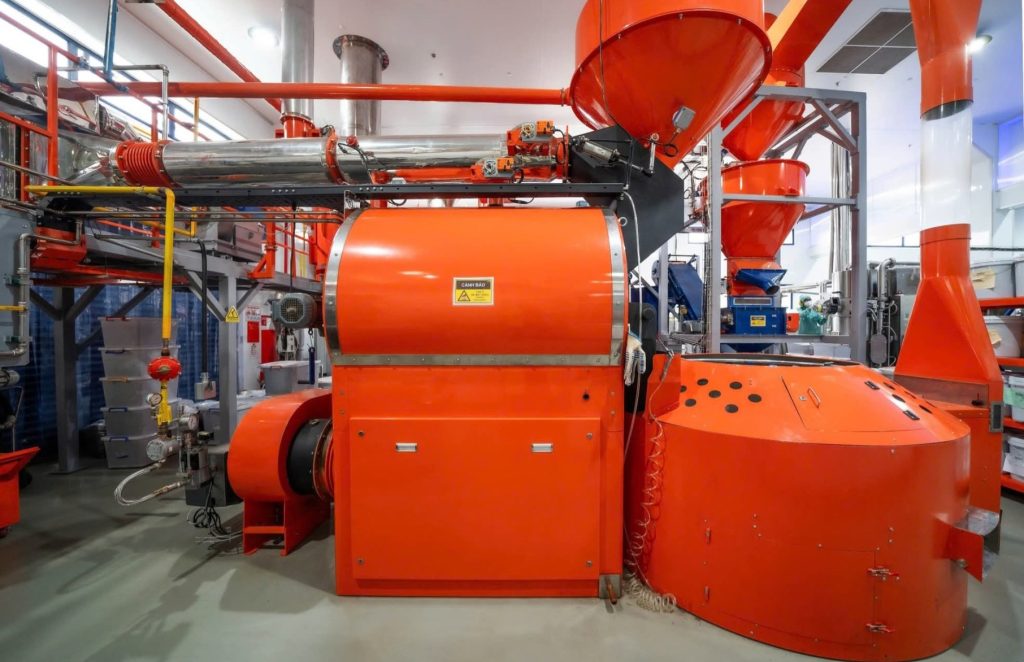
Large machines in the 100 kg class and above inevitably have to use a horizontal premix burner.
The reasons are safety (fire and gas safety) and the uniformity of large-volume roasting.
For that reason, such machines inevitably have a structure completely different from that of upward-firing burners: the lower part of a roaster that uses an upward-firing burner is completely empty, whereas
the lower part of a roaster that uses a horizontal burner becomes a kind of ‘combustion furnace.’ That is why insulation matters more than anything else.
The flame surface temperature of a horizontal premix burner reaches about 1000-1100°C. The surrounding temperature, mixed with air, is also extremely hot.
Ordinary steel cannot withstand these conditions. The commonly used SUS304 has a heat resistance limit of 800°C, so high-temperature corrosion is unavoidable.
That is why special heat-resistant steel must be used, but the problem is the cost of the material itself and how difficult it is to process.

This is exactly where the differences show up.
Let’s get straight into the comparison.
[Comparison of Internal Insulation and Chamber Structure]
Vietnamese Company A – Masonry Method
Vietnamese Company A builds the inside of its burner and drum chambers using a masonry method, stacking up refractory bricks.
This is a classic form that European manufacturers such as Probat mainly used in the past, up to the 1970s.
Because the structure uses refractory bricks and cement to withstand heat, it holds up against the heat itself, but from the viewpoint of modern roaster manufacturing it leaves much to be desired.
- Problems: The overall weight of the machine increases excessively, and there is a high risk of cracks forming from vibration during long-distance transport.
It also falls short of modern design standards in terms of long-term durability and maintenance.
Vietnamese Company B – Refractory Concrete
Next is another company in Vietnam. I was truly shocked the first time I saw the video above.
Company B builds its machines by coating the inside of the burner chamber and drum chamber, through which the hot air passes, with refractory concrete. From an engineering standpoint, this method demands considerable caution.
In general, refractory concrete and cement materials are used only in limited places, such as the ‘afterburner’ (re-combustion unit), where the airflow is exhausted and there is no direct contact with food. However, a hot-air roaster is built so that the hot air that has passed through the burner chamber flows directly onto the beans inside the drum.
- Why use this method?
It is because, although withstanding high temperatures calls for special steel designed for ultra-high heat (such as SUS 310S), coating ordinary steel plate with refractory concrete cuts costs significantly while still making it possible, at least, to withstand high heat.
- Problems: If concrete material is exposed in the passage through which the airflow runs directly, there is a risk that dust or fine particles generated by high-temperature thermal stress and vibration will be carried by the hot air and affect the beans. In addition, very few refractory concrete products meet food-safety standards, so if industrial mortar is used as it is, this results in direct exposure to heavy metals and carcinogens.
SIEBENSTER Roaster – SUS 310S + Cerakwool
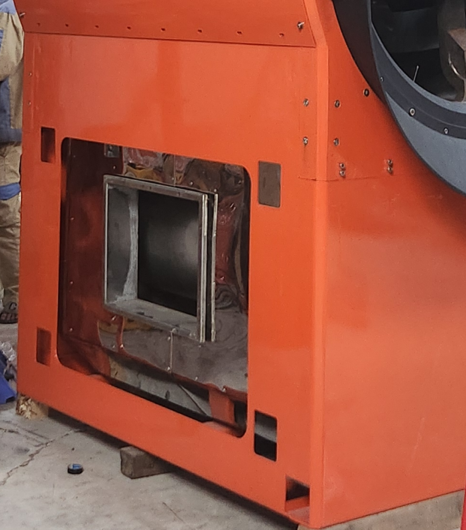
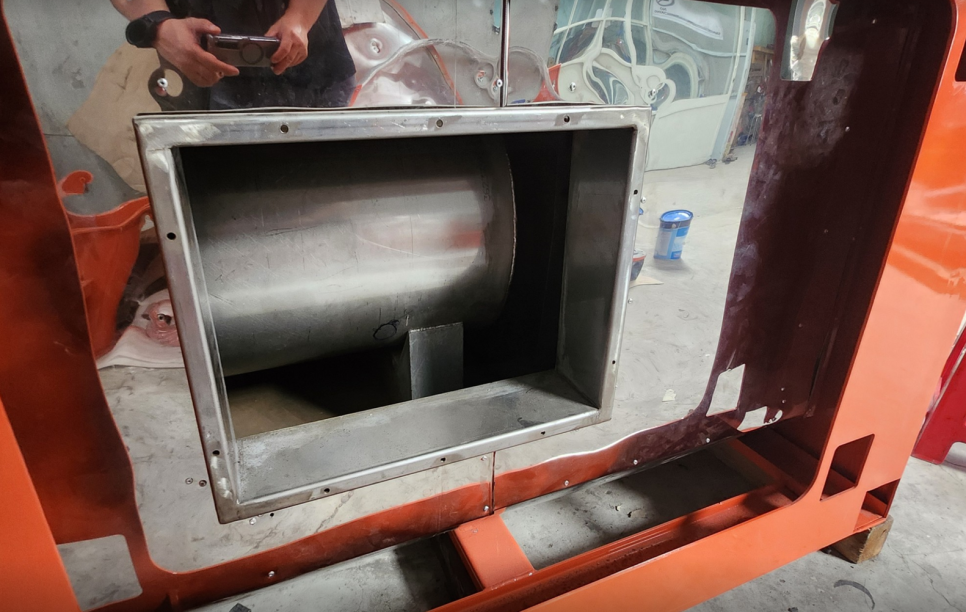
Finally, here is SIEBENSTER’s 120 kg product.
SIEBENSTER does not compromise structural safety or food hygiene in order to cut costs.
- Heat-resistant material: SUS 310S, an ultra-high-heat-resistant stainless steel, is used throughout the burner and drum chambers. It maintains a stable structure without deformation or dust generation even at temperatures of 1,000°C or higher.
- Insulation: The inside of the chamber’s double steel wall is filled and sealed with Cerakwool insulation, completely blocking heat loss.
- Result: It guarantees 100% hygienic safety of the hot air while minimizing the heat released to the outside, achieving both fuel efficiency and a comfortable working environment.
Today, we introduced how the SIEBENSTER 120 kg roaster differs structurally.
We looked at a point that is extremely important but easy to overlook.
A large roaster is a major equipment investment that, once introduced, is expected to last 10 years or more.
Even if the exteriors look similar, what materials were used for the invisible chamber interior and insulation determines the machine’s lifespan and the safety of the coffee.
The reason SIEBENSTER offers value that is both reasonable and firm compared with other companies is that we apply the safety and durability of the most fundamental materials, along with authentic plant engineering technology, and do not compromise on them.
Because this is large equipment, if you are looking for a roasting machine you can use safely and with peace of mind, please feel free to contact SIEBENSTER at any time.
No Comments