


01 Mar An Engineering Analysis of Coffee Roasting Drums: Comparing Thermodynamic Characteristics by Structure and Material
Coffee roasting is not simply a process of applying heat to green coffee.
It is an engineering process that precisely controls thermal energy in order to bring about chemical changes inside the green coffee.
At the center of this process is the ‘drum.’
The drum is the medium that receives energy from the heat source and delivers it to the green coffee, and depending on its structure and material, the flavor profile of the final product differs sharply.
This article analyzes the physical influence that a drum’s structure and material have on roasting.
1. Classification by Structural Design: Single-Wall Drum vs. Double-Wall Drum
A drum’s structural design determines the nature of the ‘conductive heat’ that comes into direct contact with the green coffee.
This is directly tied to scorching on the outer surface of the green coffee and to how evenly it is cooked.
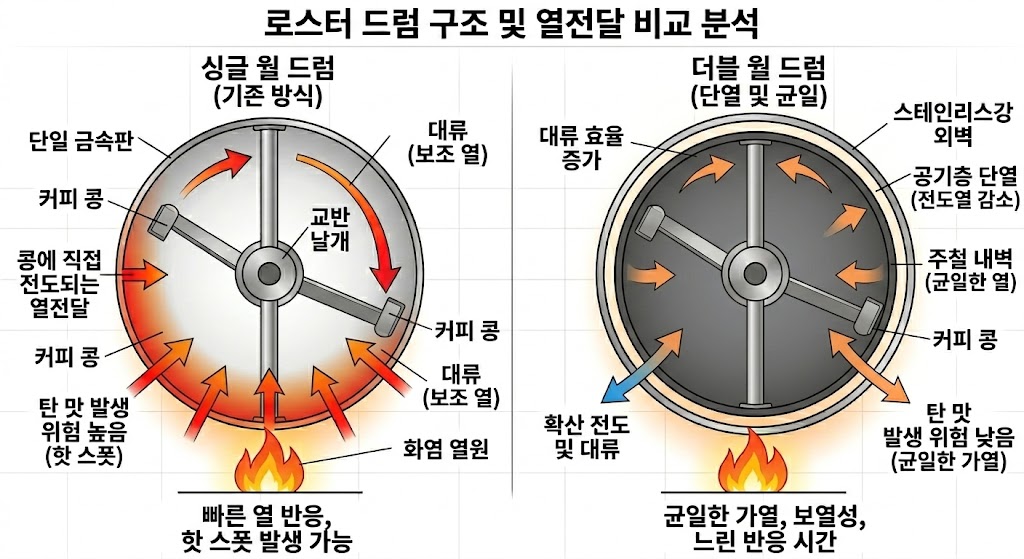
1.1 Single-Wall Drum
The single-wall drum is the most traditional type, made from a single layer of metal plate.
The heat of the flame touches the outer wall of the drum directly, and that heat is immediately transferred through the metal to the green coffee inside.
Advantages: Thermal response is very fast. When the roaster adjusts the heating power, the temperature inside the drum changes immediately, which makes dynamic profile design possible.
Disadvantages: Hot spots, specific areas touched directly by the flame, tend to form. If the drum rotation speed or heating power is handled poorly, there is a high risk of ‘scorching,’ a localized overheating of the green coffee surface.
1.2 Double-Wall Drum (Twin-Wall Drum)
The double-wall drum, now adopted in premium roasters, has a layer of air (air gap) of a set thickness between the outer wall and the inner wall of the drum.
Advantages: The air layer acts as a kind of insulator and buffer zone, dispersing the heat of the flame gently. It lowers the share of conductive heat and raises the efficiency of convective heat, which prevents damage to the surface of the green coffee and is very advantageous for cooking evenly all the way through.
Disadvantages: Thermal lag occurs. When heating power is raised or lowered, it takes time for the change to be reflected in the drum’s internal temperature, so the roaster needs the ability to anticipate and control the process.
2. Thermodynamic Analysis by Material: Cast Iron, Stainless Steel, and Carbon Steel
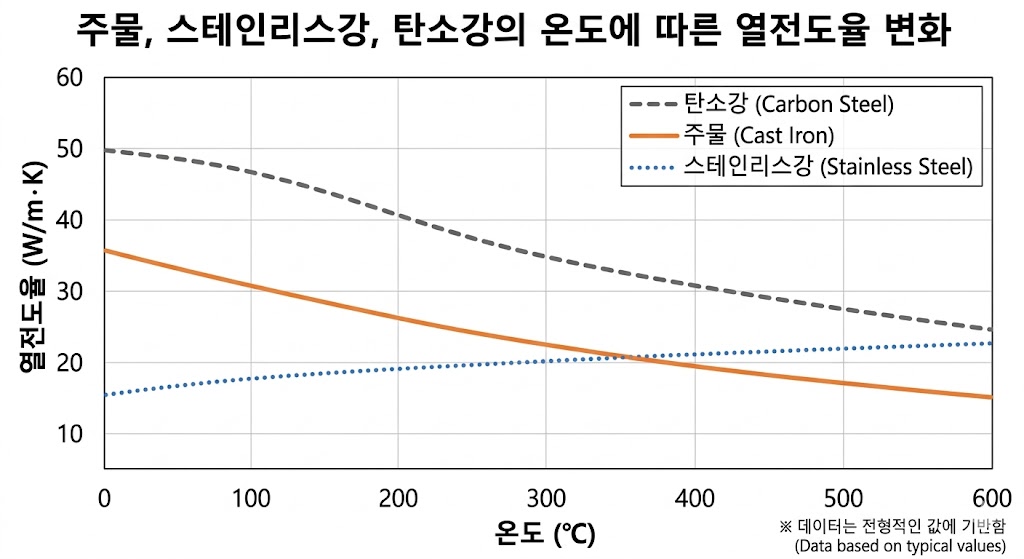
Material determines ‘thermal mass’ and ‘thermal conductivity.’
These govern the size of the initial temperature drop after charging (the Turning Point) during roasting and the ability to retain energy in the later stage.
2.1 Cast Iron Drum
Cast iron is a material made by pouring molten iron into a mold, and it is characterized by coarse grains and the presence of pores.
Thermal characteristics: Its thermal conductivity is relatively low, but its thermal mass is very large. In other words, once heated it does not cool easily, acting as a ‘reservoir of heat.’
Effect on roasting: Temperature variation between batches is small, and stable roasting is possible. The far-infrared effect characteristic of cast iron carries heat deep into the green coffee, which makes it excellent for enhancing sweetness and body. However, although it resists thermal deformation, it can be vulnerable to impact.
2.2 Stainless Steel Drum
A hygienic and sturdy material that is the most common in modern roasters.
Thermal characteristics: Low thermal conductivity and high specific heat. It transfers heat more slowly than carbon steel, but it tends to hold on to the heat it has absorbed.
Effect on roasting: It is advantageous for making coffee that is clean and showcases its acidity. However, because of its high coefficient of thermal expansion, the drum expands during roasting and can interfere with the frame, so precise design must accompany it. It is also easy to maintain and resistant to corrosion, making it suitable for commercial use.
2.3 Carbon Steel Drum (Carbon Steel / Steel Plate)
The most widely used material, with good workability and low cost.
Thermal characteristics: Excellent thermal conductivity. It is outstanding at passing energy to the green coffee instantly.
Effect on roasting: It responds immediately to delicate heating-power adjustments, so it is good for projecting the roaster’s intent. However, its thermal expansion rate is high and it can corrode (rust) when exposed to air, so continuous seasoning and maintenance are essential.
3. Key Variables in Roasting: The Relationship Between Thermal Expansion Rate, Thermal Mass, and Thermal Conductivity
A professional roaster must go beyond simply knowing the names of materials and understand how their physical values affect the roast profile.
| Category | Thermal Conductivity | Thermal Mass | Thermal Expansion Rate | Key Flavor Characteristics |
|---|---|---|---|---|
| Cast Iron | Medium | Very high | Low | Sweetness, heavy body |
| Stainless Steel (STS) | Low | Medium | High | Clean cup, distinct acidity |
| Carbon Steel | High | Medium | Very high | Bright flavors, balance |
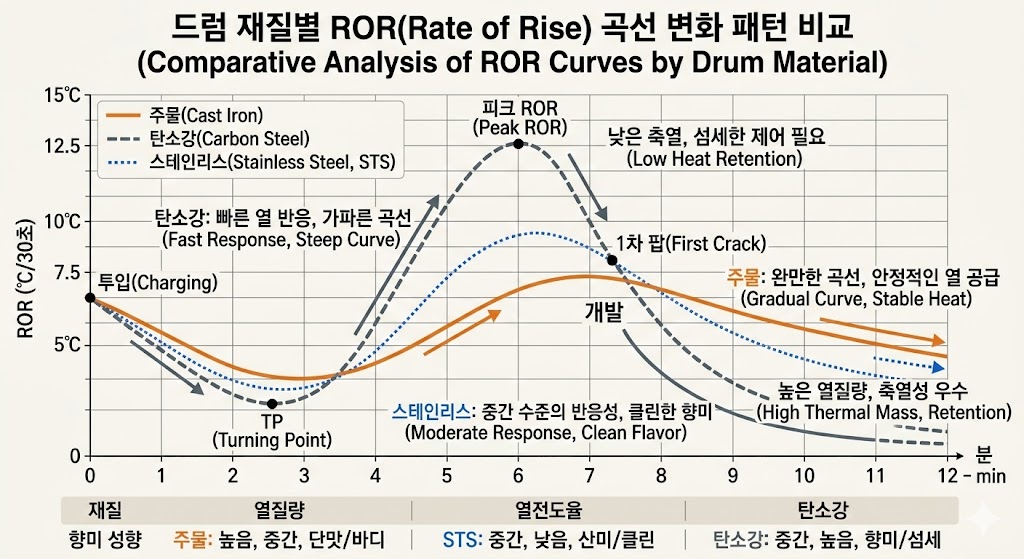
3.1 Thermal Mass & Heat Retention
A drum with a large thermal mass (cast iron, thick double-wall drums) shows a smaller temperature drop when green coffee is charged, and keeps the energy from dropping sharply after first crack.
This becomes a decisive factor in improving reproducibility when roasting consecutive batches. Conversely, a drum with a small thermal mass is sensitive to changes in the environment, so there is a risk that the result will differ from batch to batch.
3.2 Thermal Conductivity and the Share of Conductive Heat
A carbon steel single-wall drum, with its high thermal conductivity, can have a conductive-heat share of 70% or more.
This speeds up caramelization on the surface of the green coffee, but it can easily result in the outside burning before the inside is cooked.
Conversely, a double-wall drum structure raises the share of convective heat to 50-60% or more, enabling more multi-dimensional heat transfer.
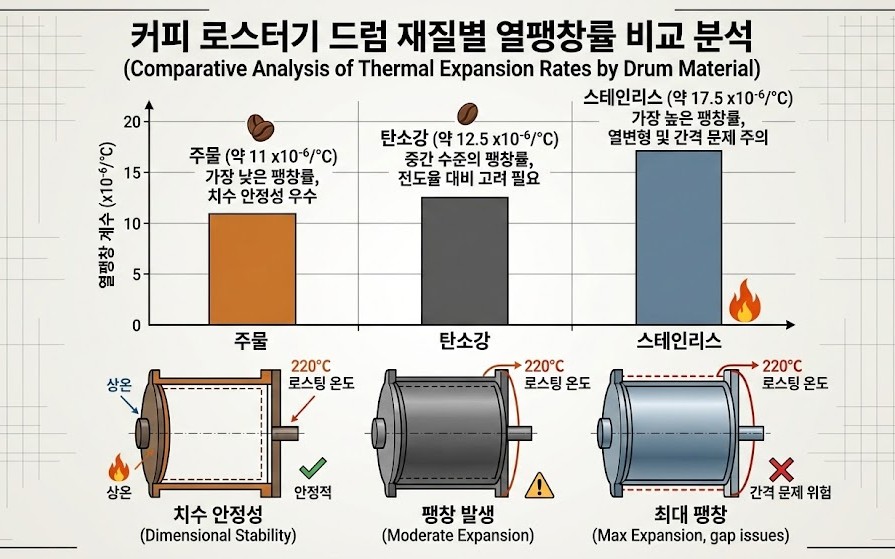
3.3 Thermal Expansion Rate and Equipment Durability
Roasting is work that moves between room temperature and high temperatures of 200°C or more. Stainless steel and carbon steel have a strong tendency to expand at high temperatures, so
the gap between the drum and the front plate can change.
If this gap widens, green coffee can get caught in it or hot air can leak out, reducing efficiency. This is exactly why professional manufacturers use cast iron frames or special alloys: to suppress this thermal deformation.
4. Recommendations for Choosing the Best Drum
A perfect drum does not exist. There is only the best choice for ‘the coffee style I pursue’ and ‘my working environment.’
- If you want stable mass production and deep sweetness: A cast iron double-wall drum model is the best choice.
- If you emphasize the delicate acidity and clean cup of specialty coffee: A precision-controlled stainless steel drum is advantageous.
- If you want to maximize the roaster’s technique and enjoy quick feedback: A carbon steel single-wall drum with good thermal conduction may be suitable.
The reason recent commercial high-end models such as the SIEBENSTER SOP-06 adopt a ‘cast iron double-wall drum’ is that
it can be seen as the engineering conclusion for achieving both ‘uniformity’ and ‘richness of flavor,’ the defining trends of modern roasting, at the same time.
Fully understanding a drum’s physical characteristics is a roaster’s first step toward drawing out 100% of the potential of the green coffee.
No Comments