


16 Oct [Roasting] How to Make Coffee Beans Swell Bigger

Today I’d like to write about how to make beans swell bigger when roasting.
A roaster is someone who roasts beans well, right? (Or at least someone who is trying to roast them well!!)
What does it mean to roast beans well?
Roasting them to taste delicious???
Ultimately, of course, that is true.
But when you actually roast, for any coffee you roast there are always some people who say it tastes good and others who say it doesn’t!
Coffee is a matter of preference, and everyone’s palate is different.
I believe that being ‘good at roasting’ means, quite literally, ‘roasting well.’
If you planned a profile before starting to roast, you can say you roast well only if you can produce a result that matches that intent.
This part is purely a matter of skill; it is never a subjective domain, and sentiment has no room to intervene.
If you say, ‘This time I’m going to pull the roast at Agtron #55,’ then when you actually measure the result, it should come out close to that number.
Likewise, if you plan, ‘This time I’m going to make the pops small!’, you can say you roast well only if you can make adjustments in advance so that it actually goes that way.
Now, today’s topic: how can we smooth out the wrinkles in the beans completely, so that the roast looks good and is good to eat?
To begin with, beans that have swelled large mean that heat was transferred effectively to the beans during roasting, raising the internal pressure so that they expanded well from the steam.
In this case, more of the coffee’s components can come out during extraction.
So in which cases should we smooth out the wrinkles in the coffee completely?
As you may have guessed, it is when extraction is short or the extraction environment is poor. Cold brew is a typical example, and when roasting for tea bags or drip bags, which use only a small amount of coffee among brewing methods, you need to let the beans pop hard and smooth out the wrinkles completely. The same goes for espresso that will be used in milk-based variation drinks!
In general, for wholesale (espresso) beans, making them swell large is good: they look good and fill the pack.
Now, let’s take a quick look at photos of two types of beans.
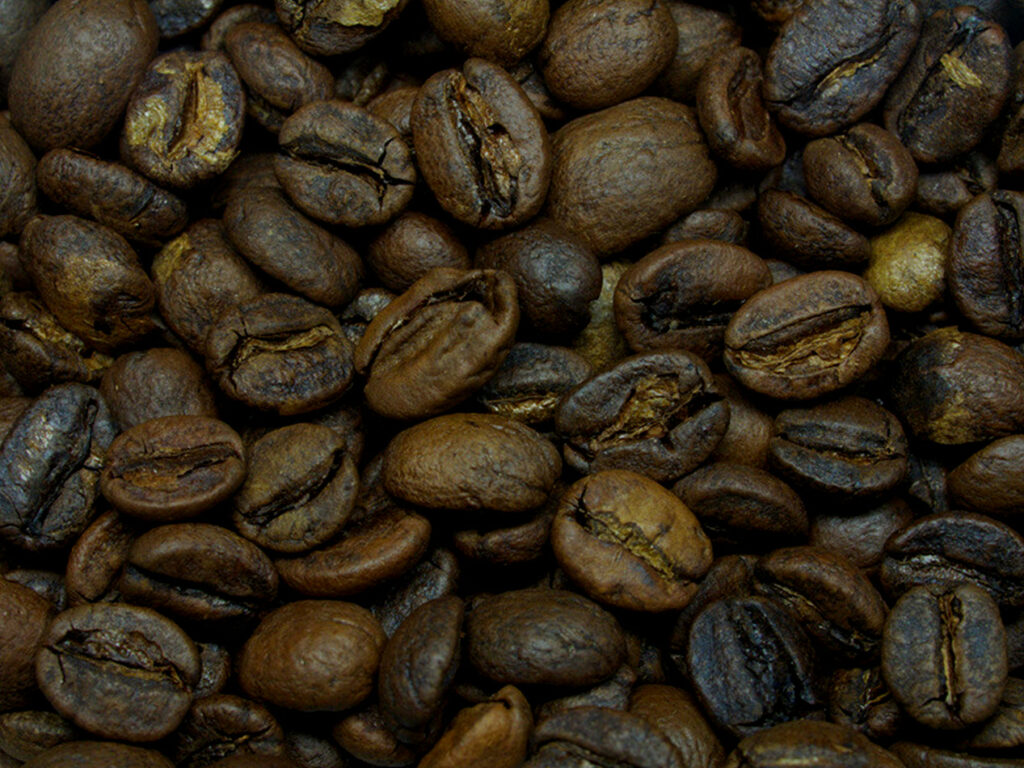
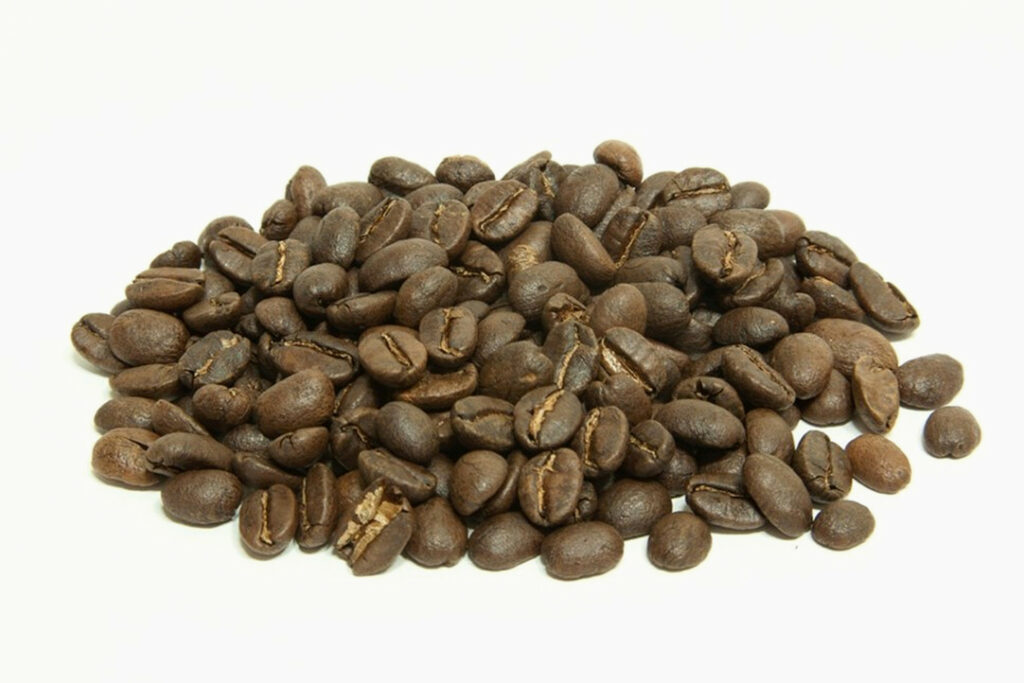
Look at the two types of beans: the difference is stark, isn’t it? The beans on the left have not fully smoothed out their wrinkles even though they were roasted further, and some of them have even burned.
If your own roasting results came out like this, what would you do about it?
How do beans swell up so that their wrinkles smooth out?
The answer lies in the dynamics between heat and moisture.
Green coffee contains moisture that we can neither see nor touch. Well, that’s only natural, haha.
But there are two kinds of this moisture, too. They are called free water and bound water.
Free water, as the name says, is moisture that is only weakly bonded to molecules and can be separated, while bound water is moisture that is attached to molecules like glue and is far from easy to separate.
The easiest way to understand bound water is to think of jam. If you squeeze jam hard, can you separate the water out of it?
Exactly, that is bound water.
When roasting begins, the moisture in green coffee is roughly 10%.
After roasting is finished, however, the moisture content of the beans is about 1-2%.
So the reason beans swell during roasting is that heat is applied to the bound water inside the green coffee and it expands.
The popping sound is the sound of the bean’s tissue bursting because it can no longer withstand the steam pressure.
Now, we’re almost there.
How much a bean swells is a matter of how efficiently heat is transferred to the coffee bean.
After all, the reason wrinkles do not fully smooth out can be seen as insufficient steam pressure.
So how can we supply heat to the beans even more efficiently? This is exactly where a roaster’s skill comes in!
At the same temperature, how can we deliver heat to the beans more efficiently?
Use conductive heat, which has a higher heat density. That said, don’t go so far that scorching occurs.
Why is that?
Which feels hotter, a hot bath or a sauna at the same temperature?
Naturally, the hot bath feels hotter. A hot bath is typically around 40°C, whereas the air in a sauna is 80°C or higher.
Then which feels hotter, a solid at 40°C or water at 40°C?
Yes, of course, the solid feels hotter.
In middle school, when we studied thermodynamics, we learned that heat is the transfer of energy and is carried by the motion of molecules or by waves.
Because density differs in the order solid > liquid > gas, at the same temperature a solid feels the hottest.
So among heat transfer methods, conduction, in which a heated object transfers heat by contact, has a higher heat density than convection, in which heating occurs through warmed air.
But!!!
There is something I must point out. Most roasters try to apply, as is, what they learned elsewhere without fully understanding the heat transfer structure of the machine they are using.
Having built roasters myself and used a wide variety of roasters already on the market, I have found that some roasters are efficient at conduction, while fluid-bed-style roasters, or roasters that are scaled up to larger sizes, will inevitably be more efficient at convection.
So you need to take the thermal efficiency of the machine you are using into account when you apply this.
Under otherwise identical conditions, slowing the drum speed to use more conduction lets you apply more concentrated heat to the beans.
However, you should understand that with a machine that is structurally efficient at convection, the overall roasting time may actually become longer.
In addition,
Please understand that the above is strictly theory, haha. In practice, because today’s larger roasters and semi-hot-air roasters have a higher convection rate than conduction rate, trying to use conductive heat can actually fail to transfer heat efficiently to the green coffee and may even end up causing scorching.
What I recommend is raising the share of conductive heat only up to the stage just before yellowing. A loud popping sound means the internal steam pressure is high, so it would be good to use that as a hint.
Alright then, now let’s give it a try~~~
No Comments