


16 Oct [Roasting] Correcting Roasting Defects After Cupping!

Do you cup after roasting?
In truth, it isn’t as easy as it sounds.
But when it comes to how important it is, you can never stress it enough!
Ceaseless Check & Balance on your own roasting. That is the shortcut to improving your ‘roasting ability.’
There is always a gap between theory and reality, so the praxis of roasting is nothing more than the repeated process of adjusting your roast based on feedback from cupping.
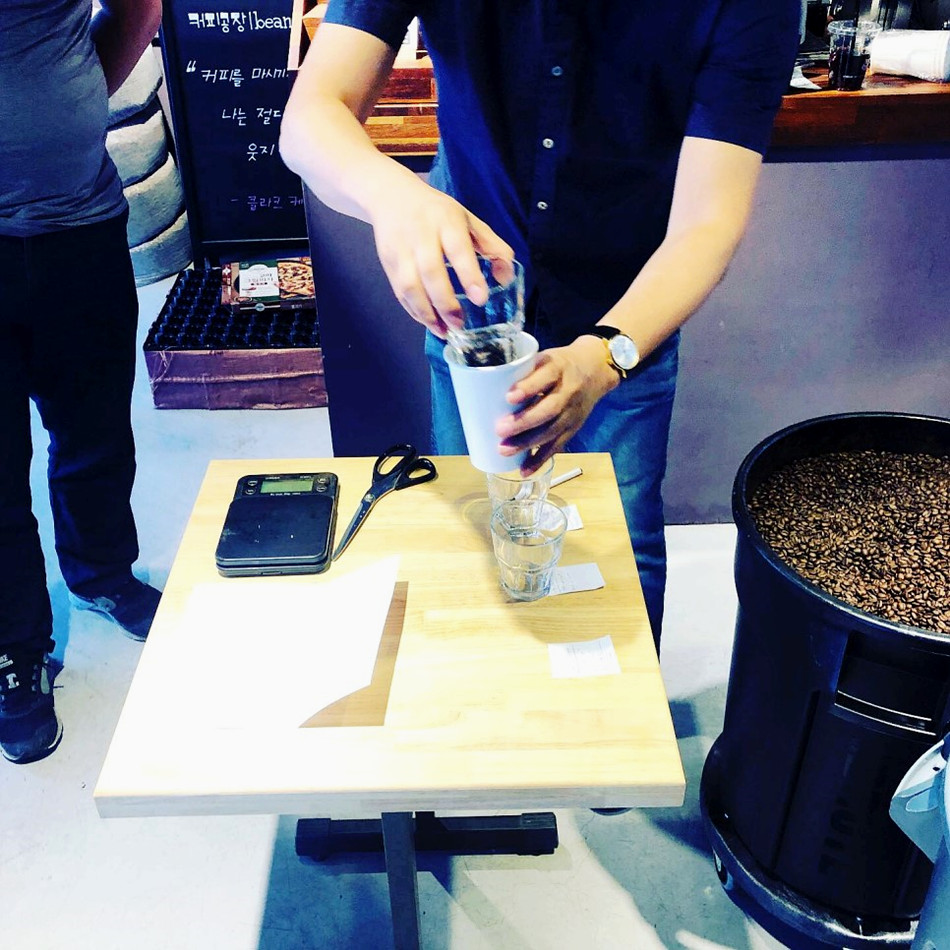
Coffee Press continually conducts cupping tailored to the requirements of the wholesale clients it supplies.
Today we are cupping with the coffee prepared as an Americano. For clients who use automatic machines, we brew with an automatic machine, and for milk-based variations, we evaluate the espresso itself as well as whether the espresso holds up against the milk.
In this post, I would like to introduce a few ways to correct your roast after cupping.
Shall we get started?
| When You Get a Grassy Flavor
A grassy flavor. In technical terms, this is called underdevelopment. The main cause of underdevelopment is roasting too fast.
A grassy flavor appears when the inside of the bean has not developed properly, so you need to apply enough heat. Also, take care that poor heat control does not create a segment on the roast curve graph where the temperature drops or stays flat.
These days, among green coffee dried in mechanical dryers during processing (Colombian coffee is a typical example), we find quite a few beans whose center cut has not dried sufficiently. So if a strong grassy flavor persists, it would be better to raise the roast level a little or replace the green coffee.
| Baked
Baked beans show up as a taste of paper or straw, or a bitterness that does not suit the roast level. This typically occurs in beans with insufficient moisture content. In this case, shortening the roasting time is best.
When you actually measure it, there is no separate ‘drying phase’ for moisture. In theory moisture is divided into free water and bound water, but the internal moisture content evaporates at a steady rate, down to a little over 2% in the end.
To improve this, you would have to manage the roast from the caramelization stage, where a bean with insufficient moisture oxidizes itself, but in practice it is usually compensated for by adjusting the resting time.
| Spicy or Smoky
An acrid taste sometimes comes from the green coffee itself, but in many cases it occurs when the chaff burns or the exhaust is not flowing smoothly. People accustomed to Japanese-style roasting sometimes close the damper to trap the aroma, but even if the aroma is trapped, the negative aromas are trapped along with it, and that seems to be more of a loss than a gain for the roast. In general, as roasting progresses the volume of the green coffee expands and chaff comes loose, so the exhaust airflow needs to be increased over time.
| Salty Taste
I have read that people who drank a lot of coffee in the past mistake sourness for saltiness, but I don’t know much about that, so let’s skip it. There are also cases where people commonly perceive a salty taste, and this generally appears when the coffee is considerably underdeveloped. I recommend raising the charge temperature or using stronger heating power overall, and if that is not feasible either, roasting below the standard batch size so that heat is transferred to the beans more efficiently is another option.
I hope this post has been at least a little helpful.
Let me say it once more: knowing is the same as having done nothing.
You have to try it yourself. haha
No Comments